Multiview Geometry
September 04, 2022
Multi-view Geometry
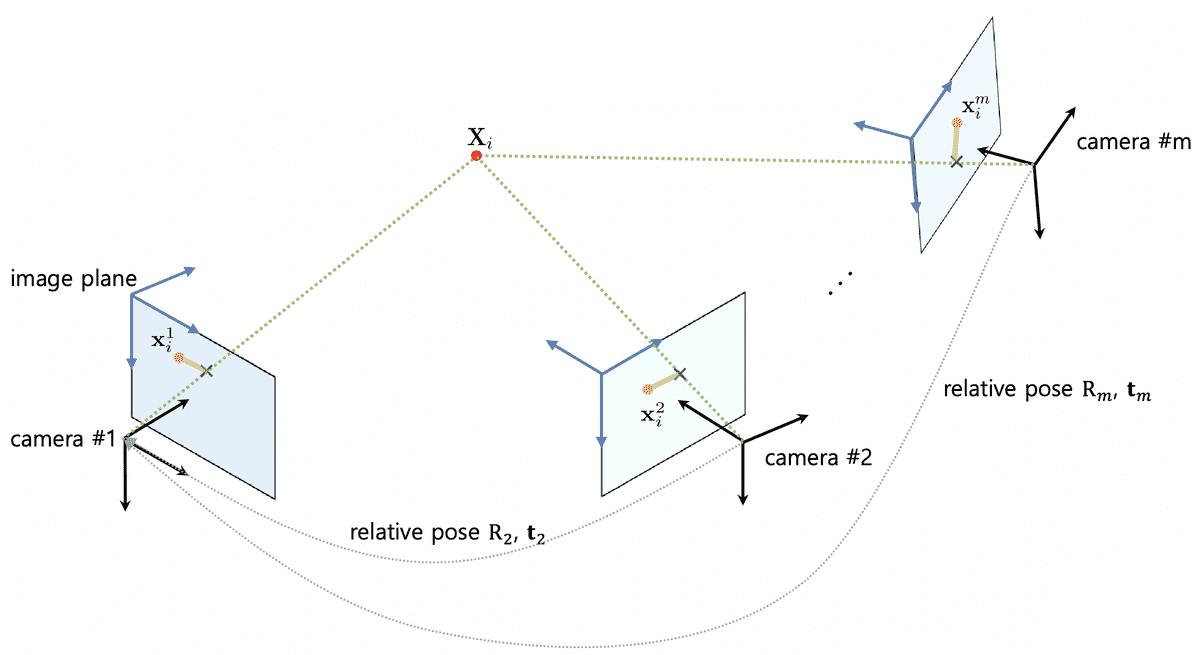
Bundle Adjustment
-
Unknown
Position of 3D pointsandeach camera’s relative pose( DoF)
-
Given
- Point correspondence
- camera matrices
- position of 3D points
- each camera’s relative pose
-
Constraints
-
Solution ⇒ Non-linear least-square optimization
-
Cost Function
-
Reprojection error
-
-
Optimization
- Levenberg–Marquardt method
- Gauss-Newton method
-
Bundle Adjustment and Optimization Tools
-
OpenCV
- No function (but cvsba is available as a sba wrapper.)
-
Bundle adjustment
-
(Graph) Optimization
- g2o (General Graph Optimization)
- iSAM (Incremental Smoothing and Mapping)
- GTSAM
- Ceres Solver (Google)
Applications
Structure-from-motion
-
SfM (Global)
-
Build a viewing graph (well-matched pairs) while finding inliers
⇒ Load images and extract features
⇒ Match features and find good matches (which has enough inliers)
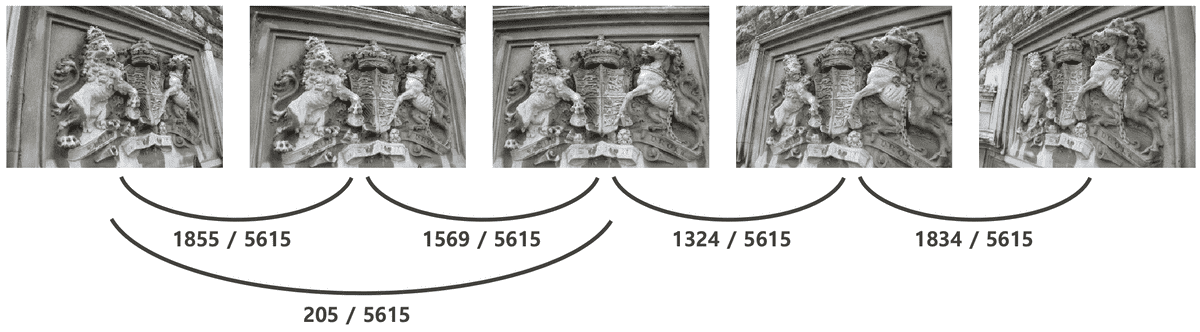
- Initialize cameras ()
- Initialize 3D points and build a visibility graph
-
Optimize camera pose and 3D points together (BA)
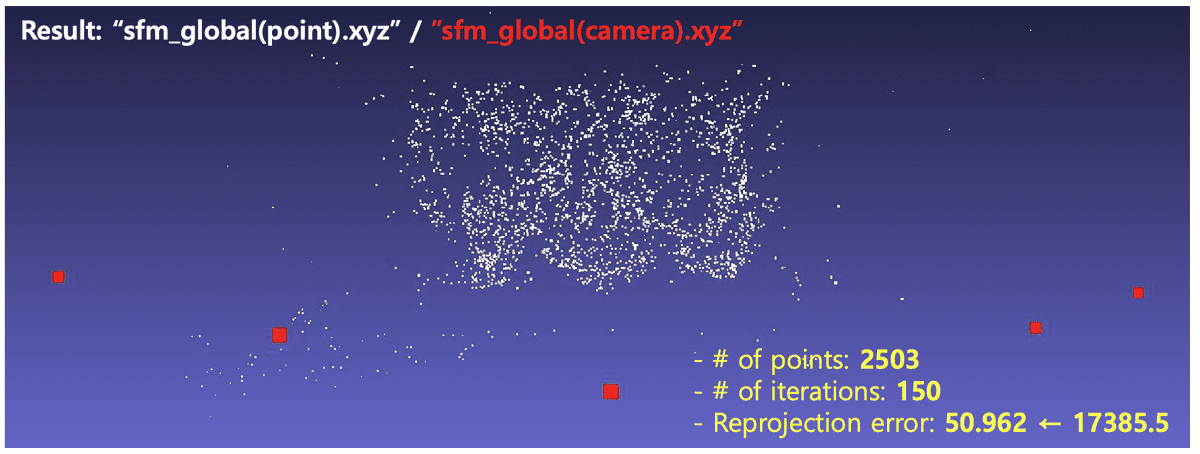
-
-
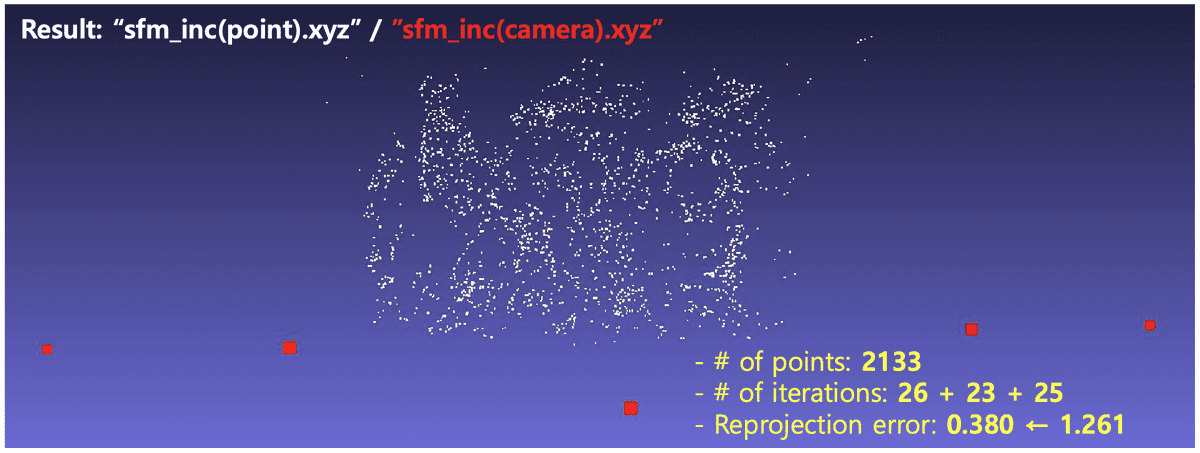
SfM (Incremental)
- Incrementally add more views
- repeat 4~7
- Build a viewing graph (well-matched pairs) while finding inliers
- Select the best pair
- Estimate relative pose from the best two views (epipolar geometry)
- Reconstruct 3D points of the best two views (triangulation)
-
Select the next image to add
⇒ Separate points into known and unknown for PnP (known) and triangulation (unknown)
- Estimate relative pose of the next view (PnP)
- Reconstruct newly observed 3D points (triangulation)
- Optimize camera pose and 3D points together (BA)
Visual SLAM
-
Feature-based MethodvsDirect Method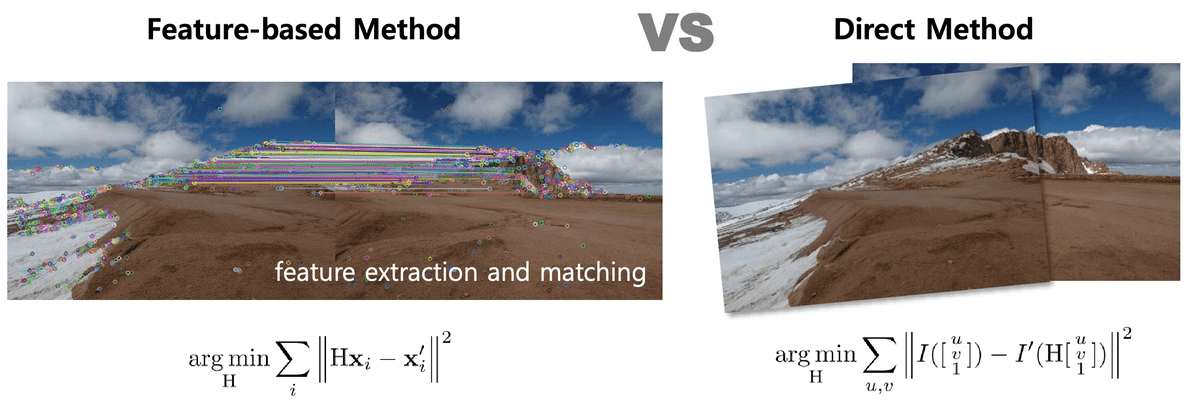

Visual Odometry
-
Visual OdometryvsWheel OdometryVisual Odometry Wheel Odometry + direct motion measure + simple calculation + six degree-of-freedoms + easy to install − heavy computation − indirect motion measure (e.g. slippage) − visual disturbance (e.g. moving objects) − two degree-of-freedoms − necessary to be on rotor/shaft -
Visual OdometryvsVisual SLAM-
Visual Odometry
-
no assumption on trajectories
⇒ navigation / large space (outdoor)
-
-
Visual SLAM
-
closed-loop is preferred for convergence
⇒ mapping / small space (indoor, campus)
-
-
-
Feature-based Monocular Visual Odometry
-
Two-view Motion Estimation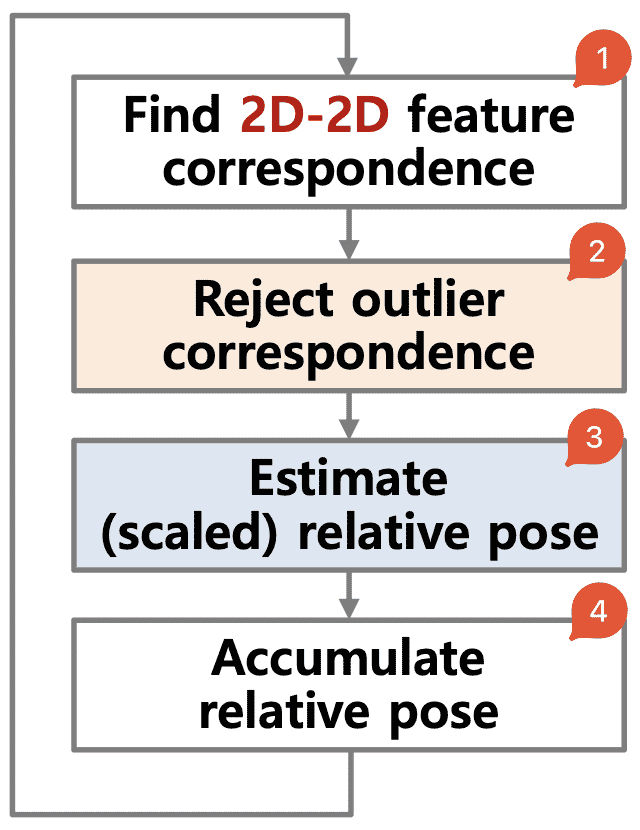
-
Find 2D-2D feature correspondence
-
Feature
→ Good-Feature-to-Track [Shi94_CVPR] with bucketing to distribute features
-
Correspondence
→ Lucas-Kanade optical flow [Lucas81_IJCAI]
-
-
Reject outlier correspondence
- Adaptive MSAC [Choi09_IROS]
- Iterative 5-point algorithm [Choi15_IJCAS]
-
Error measure
→ Sampson distance
-
Estimate (scaled) relative pose
- Normalized 8-point algorithm
- Scale-from-ground with asymmetric kernels [Choi13_URAI]
-
-
PnP Pose Estimation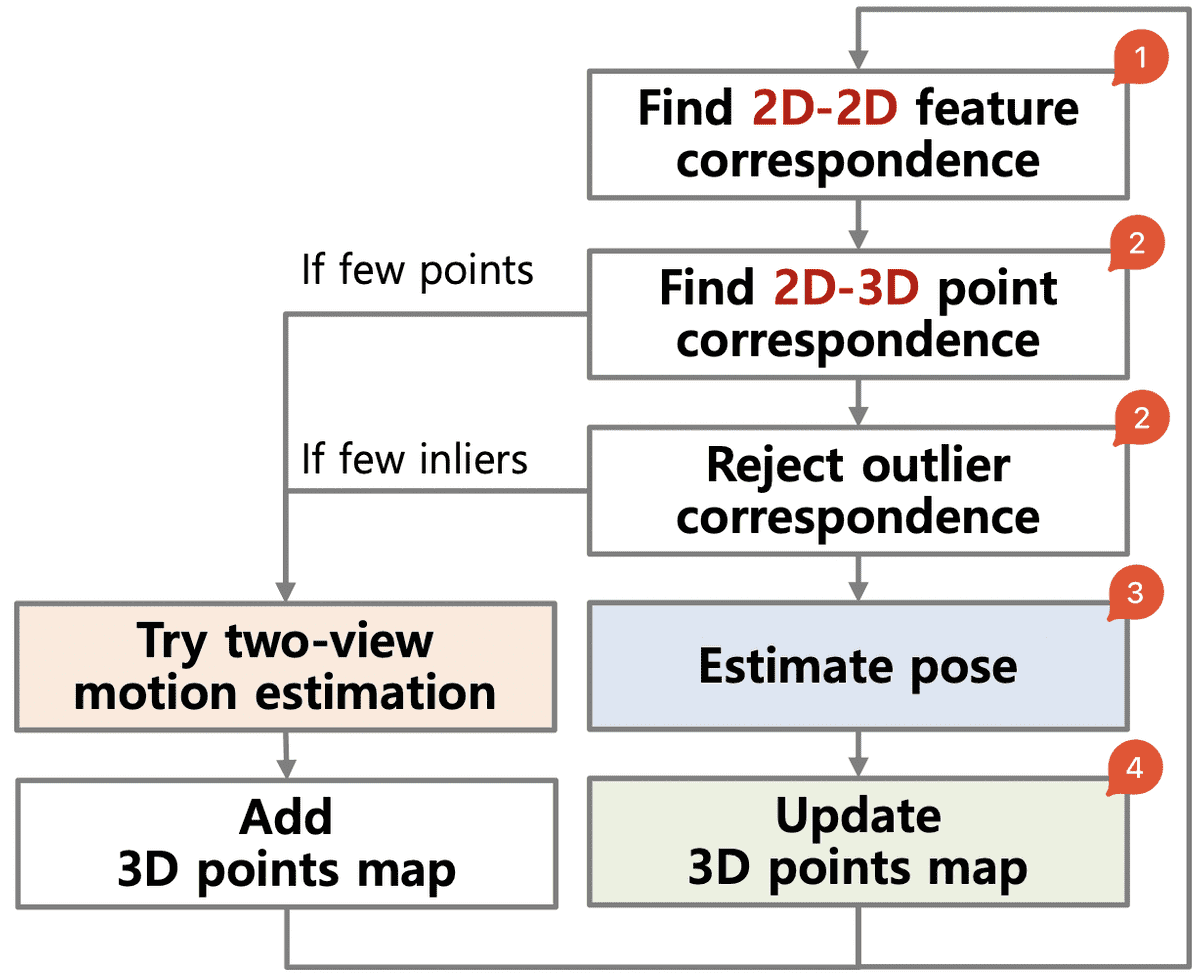
-
Find 2D-2D feature correspondence
-
Feature
→ Good-Feature-to-Track [Shi94_CVPR] with bucketing to distribute features
-
Correspondence
→ Lucas-Kanade optical flow [Lucas81_IJCAI]
-
-
Find 2D-3D point correspondence & Reject outlier correspondence
- Adaptive MSAC
- Iterative PnP algorithm (3-point algorithm)
-
Error measure
→ Projection error
-
Estimate pose
- Iterative PnP algorithm
- Scale-from-ground with asymmetric kernels [Choi13_URAI]
-
Updat 3D points map
- Bundle adjustment over last keyframes Reprojection error with Cauchy loss function
-
-

